Black Morpho Tetra
$6.99 USD


- Fully quarantined fish
- Professionally packed
- Live arrival guarantee
Regular price
$6.99 USD
Sale price
$6.99 USD
Regular price
Unit price
per
Shipping starts at $22.99 depending on your location
Couldn't load pickup availability
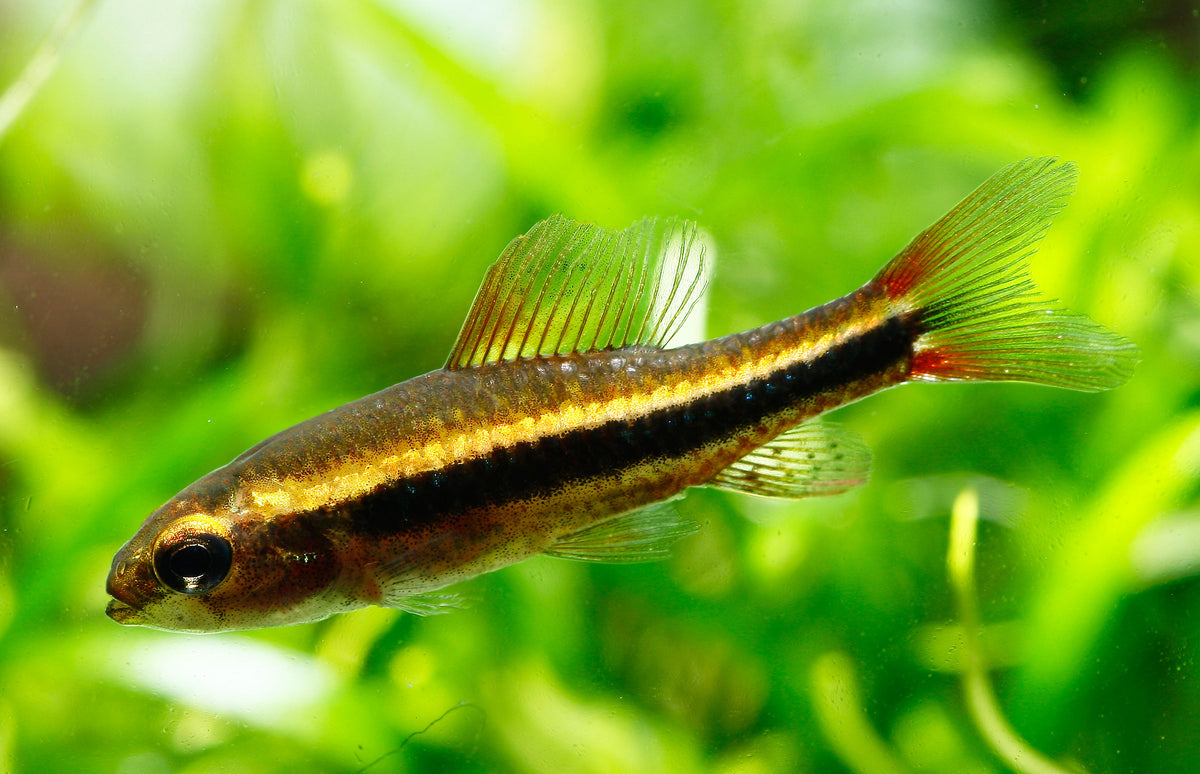
Black Morpho Tetra, Poecilocharax weitzmani, is a spectacular South American characin native to the upper Amazon and Orinoco basins, with populations recorded in Colombia, Venezuela, Brazil, and Peru. Commonly associated with the name Black Darter Tetra, this small species inhabits shaded forest streams and blackwater tributaries with extremely soft, acidic water, submerged roots, fallen branches, and thick accumulations of leaf litter. Unlike conventional schooling tetras, Black Morpho Tetras spend much of their time close to the substrate, moving deliberately among leaves and submerged structures. Their unusual behavior, remarkable coloration, and striking sexual dimorphism make them one of the most fascinating small characins available in the aquarium hobby.
Adult Black Morpho Tetras typically reach about 1.5 to 2 inches in length. Their body is slender and elongated, with a distinctive pointed head and relatively large fins. Mature males are especially spectacular, displaying a dark charcoal to nearly black body accented by brilliant electric-blue, turquoise, and violet iridescence. Depending on lighting and viewing angle, the metallic coloration can produce an almost butterfly-like shimmer reminiscent of a Blue Morpho butterfly. Males develop beautifully extended dorsal and anal fins, often decorated with contrasting dark pigmentation, metallic blue highlights, and subtle reddish tones. Females are generally smaller, fuller-bodied, and considerably less colorful, displaying more subdued brownish, gray, and cream coloration with darker longitudinal markings. The dramatic contrast between mature males and females makes this species particularly interesting to maintain in mixed groups.
A mature aquarium of at least 20 gallons is recommended for a small group, although larger aquariums provide more opportunities for establishing territories and observing natural behavior. Black Morpho Tetras are best maintained in heavily structured aquariums with abundant driftwood, fine branches, leaf litter, caves, and dense plant cover. Fine sand is an excellent substrate, particularly when covered with scattered botanicals that create natural hiding places. Subdued lighting and floating plants help recreate their shaded forest habitat. Unlike active open-water tetras, these fish prefer to remain near the bottom and among cover, so horizontal space and numerous visual barriers are more important than extensive open swimming areas.
Water conditions should remain exceptionally clean, soft, and acidic. Temperatures between 74 and 82 degrees Fahrenheit are appropriate, with a pH range of approximately 4.0 to 6.5 and very low carbonate hardness preferred. Wild specimens are particularly well adapted to mineral-poor blackwater conditions and may be sensitive to hard, alkaline water. Reverse-osmosis water, natural botanicals, and gentle filtration can be useful for maintaining suitable conditions. Stability is especially important, as sudden changes in water chemistry can be stressful for this specialized species.
Black Morpho Tetras are micropredators that naturally feed on tiny aquatic insects, insect larvae, crustaceans, worms, and other small invertebrates found among leaf litter and submerged vegetation. In the aquarium they thrive on appropriately sized live and frozen foods such as baby brine shrimp, daphnia, cyclops, mosquito larvae, and small bloodworms. Some individuals may eventually accept high-quality micro-pellets, but wild specimens can be reluctant to recognize dry prepared foods. A varied diet containing regular live or frozen foods is strongly recommended for maintaining excellent condition and developing the spectacular coloration of mature males.
Temperament is generally peaceful toward unrelated species but can be territorial among males. Rather than forming tight schools, Black Morpho Tetras establish small territories and spend much of their time displaying, exploring cover, and interacting near the substrate. Mature males may flare their fins and intensify their colors when encountering rivals, making these displays one of the highlights of keeping the species. They are best maintained in species-focused aquariums or carefully planned blackwater communities with small, peaceful tankmates such as pencilfish and other gentle characins. Larger, aggressive, or highly competitive fish should be avoided.
Breeding is possible in captivity but requires carefully maintained conditions. Unlike typical egg-scattering tetras, Poecilocharax weitzmani is a cave-spawning species. Males establish territories around small cavities or sheltered spaces, where females deposit adhesive eggs. The male guards the eggs until they hatch, displaying parental behavior that is unusual among small aquarium characins. Very soft, acidic water and abundant appropriately sized live foods are particularly important for breeding success. Newly hatched fry require microscopic foods before progressing to newly hatched brine shrimp.
Poecilocharax weitzmani is one of the most extraordinary small South American characins available to dedicated aquarists. Its dramatic black and electric-blue coloration, elaborate male finnage, unusual bottom-oriented behavior, and fascinating cave-spawning strategy distinguish the Black Morpho Tetra from conventional schooling species. For aquarists interested in rare blackwater fish, this remarkable species offers an exceptional combination of beauty, personality, and fascinating natural behavior.